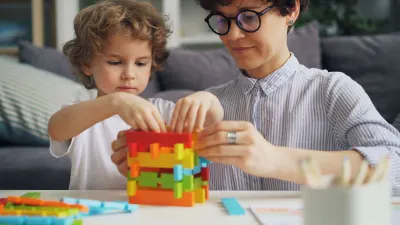
You can develop a child’s attention with structured ABA therapy games - applied behavior analysis breaks complex skills into simple steps with clear prompts and reinforcement. Below are nine practical exercises you can start using today.
What attention means in ABA therapy
Attention is a child’s ability to keep their focus on a particular stimulus, task or person for a certain time without getting distracted. In applied behavior analysis, attention is seen not as an abstract character trait but as a skill that can be trained through repetition, prompts and reinforcement.
ABA therapy (Applied Behavior Analysis) is a scientifically grounded approach to developing behavior that uses the principles of learning to build useful skills and reduce unwanted reactions. It is widely used with children on the autism spectrum, but its principles work for any child.
Key concepts worth understanding before you start:
- Prompt - help an adult gives the child to complete a task.
- Reinforcement - a reward that makes a desired behavior more likely to happen again.
- Generalization - the ability to use a skill in different conditions, not just during a session.
According to practicing ABA therapists, regularity and consistency matter more than length: short daily practice gives more stable results than rare long sessions.
Basic principles of attention games
Before moving on to specific games, it’s important to understand a few basic rules that every ABA exercise is built on.
Session structure
Each game has a clear structure: instruction → prompt (if needed) → the child’s response → reinforcement → recording the result. This sequence lets you track progress and adjust the approach in time.
Choosing reinforcement
Reinforcement must be meaningful to your particular child - praise, a favorite toy, a short break or a sticker. There is no universal reinforcer.
Gradual progression
A task gets harder only after the child consistently (in 80–90% of cases) completes the previous level.
9 games to develop your child’s attention
Below are safe, basic examples of games you can use at home.
- “Find the pair” - lay out a few matching cards and ask the child to find the identical ones. Develops visual attention and concentration.
- “Freeze” - the child moves to music and stops as soon as it stops. Trains voluntary attention and self-control.
- “What’s missing?” - show 3–4 items, cover them, remove one and ask what’s missing.
- “Sort by feature” - ask the child to sort items by color, shape or size.
- “Listen and repeat” - say a short sequence of words or sounds and the child repeats it.
- “Spot the difference” - use two almost identical pictures to compare.
- “Follow my finger” - move an object slowly and the child follows it with their eyes without looking away.
- “Odd one out” - among several items from one category, there is one that doesn’t belong and needs to be found.
- “Step by step” - give a simple two-part instruction (“take the ball and put it in the basket”) and check whether it is completed fully.
Table: difficulty and goal of each game
| Game | Skill developed | Recommended age | Approximate length |
|---|---|---|---|
| Find the pair | Visual attention | 3+ | 5–7 min |
| Freeze | Voluntary attention, self-control | 3+ | 5–10 min |
| What’s missing? | Working memory + attention | 4+ | 5 min |
| Sort by feature | Categorization, concentration | 3+ | 7–10 min |
| Listen and repeat | Auditory attention | 4+ | 5 min |
| Spot the difference | Sustained attention | 5+ | 7 min |
| Follow my finger | Visual tracking | 3+ | 3–5 min |
| Odd one out | Analytical attention | 4+ | 5–7 min |
| Step by step | Following instructions | 3+ | 5 min |
Common parent mistakes
- Making the task too hard right away. This leads to frustration and refusing to play.
- No clear reinforcement. Without rewards, the child loses motivation to keep going.
- Irregular sessions. Chaotic sessions “when we’re in the mood” give much weaker results than short daily practice.
- Ignoring signs of tiredness. End the session before the child is completely exhausted.
- Comparing with other children. Every child develops at their own pace, and comparisons only hurt motivation.
When you need a specialist
The games above are basic, safe exercises suitable for home. But if your child’s attention doesn’t improve after several weeks of regular practice, or there are also difficulties with behavior, speech or communication, it’s worth seeing a qualified ABA therapist. The specialist will carry out an assessment, set an individual program and choose reinforcers that work for your child.
It’s important to understand that games at home are only a first step. Full work on a child’s attention, behavior and communication requires a systematic approach, a sequence of steps and the ability to adjust the program based on data - which is exactly what specialized ABA therapy courses teach.
If you want a complete step-by-step system, ready-made templates, checklists and real case studies, take a look at the online ABA therapy course, which explains the sequence of actions and practical tasks in detail. A one-to-one consultation with Alina is included only in the Platinum plan.
Frequently asked questions
From what age can ABA attention games start?
Elements of ABA therapy can be used from 2–3 years, adapting the difficulty to the child’s age.
How much time should these games take each day?
To start, 10–15 minutes a few times a day is enough, gradually increasing the length.
Can these games be used without an ASD diagnosis?
Yes. ABA principles are effective for developing attention in any child, with or without a diagnosis.
What if my child refuses to play?
Try making the task easier, changing the reinforcement or shortening the session.
How are ABA games different from ordinary educational games?
ABA games have a clear structure: an instruction, a prompt, reinforcement and recording the result, which makes progress measurable.
When should I see a specialist instead of practicing on my own?
If your child’s attention doesn’t improve after several weeks, or there are also difficulties with behavior or communication, consult an ABA therapist.